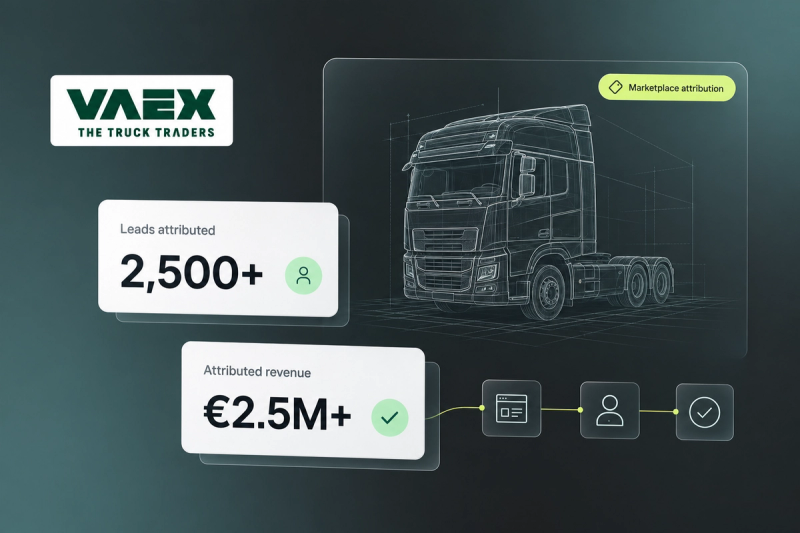
VAEX Truck Trading already had plenty of leads. The problem was knowing which marketplaces actually generated sales.
By connecting leads from email, WhatsApp, phone, website forms and chat to their original source, Octanist gave VAEX Truck Trading something they had never had before: a clear view of which marketplaces generate leads, which generate customers, and ultimately, which generate revenue.
About VAEX Truck Trading
VAEX Truck Trading buys and sells trucks and commercial vehicles.
To reach potential buyers, VAEX Truck Trading advertises its inventory across a wide range of online vehicle marketplaces, alongside channels such as Google Ads.
For years, the strategy was straightforward: list the vehicles on as many relevant marketplaces as possible. More visibility meant more inquiries, and more inquiries should eventually mean more sales.
And the leads were certainly coming in.
The problem was what happened after that.
The Challenge: Plenty of leads, but little visibility into what they were worth
Marketplace contracts represent a significant annual investment for VAEX Truck Trading.
As that investment grew, management started asking a logical question:
What are these marketplaces actually delivering for us?
VAEX Truck Trading could see inquiries coming in, but lead volume alone could not answer that question.
A potential buyer might contact VAEX Truck Trading through WhatsApp after finding a truck on a marketplace. Another might call. Others would send an email, start a chat or fill in a form on the website.
Once those conversations entered the sales process, it was difficult to reliably connect the eventual sale back to the marketplace that originally generated the buyer.
That meant a marketplace generating hundreds of leads could easily look successful, even if very few of those leads ever bought a truck.
There was no reliable way to compare platforms based on the metric that ultimately matters: sales and revenue.
The Solution: Connecting every lead to its original source
VAEX Truck Trading brought in an online marketer to solve the measurement problem, who turned to Octanist for the attribution between lead source and final sales outcome.
With Octanist, leads from VAEX's different contact channels are brought together and attributed to the source that generated them.
Whether someone contacts VAEX Truck Trading by:
- phone
- website form
- chat
the lead can be connected back to the relevant marketplace or marketing source.
VAEX Truck Trading then qualifies its leads as part of its normal sales process. When a lead turns into a customer, the sale and its revenue remain connected to the original source.
The result is a completely different way of evaluating marketplace performance.
Instead of:
How many leads did this marketplace generate?
VAEX Truck Trading can now ask:
How many of those leads became customers, and how much revenue did they generate?
What the Data Revealed
Once VAEX Truck Trading could compare marketplaces beyond lead volume, major differences became visible.
One marketplace had generated hundreds of leads. On lead volume alone, it looked like an important source.
But its sales performance told a very different story.
At the time of analysis, its won rate was closer to 0% than 1%. Some leads are still open and could convert in the future, but these inquiries are already older.
In other words: a large number of inquiries had created a lot of activity, while very few had resulted in a sale so far.
At the other end of the spectrum, another marketplace generated far fewer leads.
Looking only at lead volume, it would have been easy to consider this a relatively small channel.
But more than one in ten leads from this marketplace became a customer, making its sales rate several times higher than many of the larger marketplaces.
That changes the conversation completely.
The marketplace producing the most leads is not automatically the marketplace creating the most value.
And a platform that looks small in a lead report can suddenly become one of the most interesting opportunities when actual sales are taken into account.
From Lead Volume to Revenue Attribution
This is where Octanist changed the way VAEX Truck Trading can evaluate its marketplace strategy.
Octanist turned VAEX's marketplace strategy from one based on lead volume into one based on actual sales and revenue.
VAEX Truck Trading can now see where marketplace investments deserve more attention, where performance needs to be questioned, and where a high volume of leads may be creating more work than business.
That information becomes especially valuable when marketplace contracts come up for renewal.
Instead of deciding based on visibility, lead volume or gut feeling, VAEX Truck Trading can enter those discussions with evidence:
- Which marketplaces generate serious opportunities?
- Which marketplaces actually generate customers?
- Which sources contribute the most revenue?
- Which high-volume platforms barely convert?
- Which smaller platforms deserve more attention?
For the first time, VAEX Truck Trading has the data to make those decisions and justify them to management.
The Impact
Octanist did not solve a lead generation problem for VAEX Truck Trading.
There wasn't one.
VAEX Truck Trading already generated hundreds of leads through its marketplaces and other marketing channels.
The problem was that they could not see which of those leads were actually worth something.
Now with the offline conversion tracking services and the call tracking connection they can.
And when multiple marketplace contracts represent a substantial annual investment, knowing the difference between a platform that generates activity and a platform that generates customers can have a major impact on where the next marketing euro is spent.
VAEX Truck Trading can now make marketplace investment decisions based on customers and revenue instead of lead counts.
What's Next
The new insight also raised the logical next question: what happens when marketplace costs are placed directly alongside the customers and revenue they generate?
VAEX Truck Trading already knows what each marketplace costs annually. Based on discussions with the team, Octanist is exploring ways to bring those costs into the custom platform as well, making it even easier to compare investment with actual business results. For standard ad platforms like Google Ads, Meta ads etc, this is already included.
It is also a good example of how customer feedback helps shape the Octanist roadmap.
Stop Counting Leads. Start Measuring What They Become.
A lead is only the beginning.
If your business generates leads through marketplaces, advertising platforms or other paid channels, knowing how many inquiries each source generates is not enough.
Octanist connects those leads to what happens afterwards, so you can see which sources generate qualified opportunities, customers and revenue.
Don't track leads. Track value.